
Subject
Loading subject…
Loading articles and connected sources…
Loading articles and connected sources…
Stars, galaxies and the observable universe
No articles in this subject yet.
Relevant records from public research, reference, imagery, and data sources. Each result links to its original source.
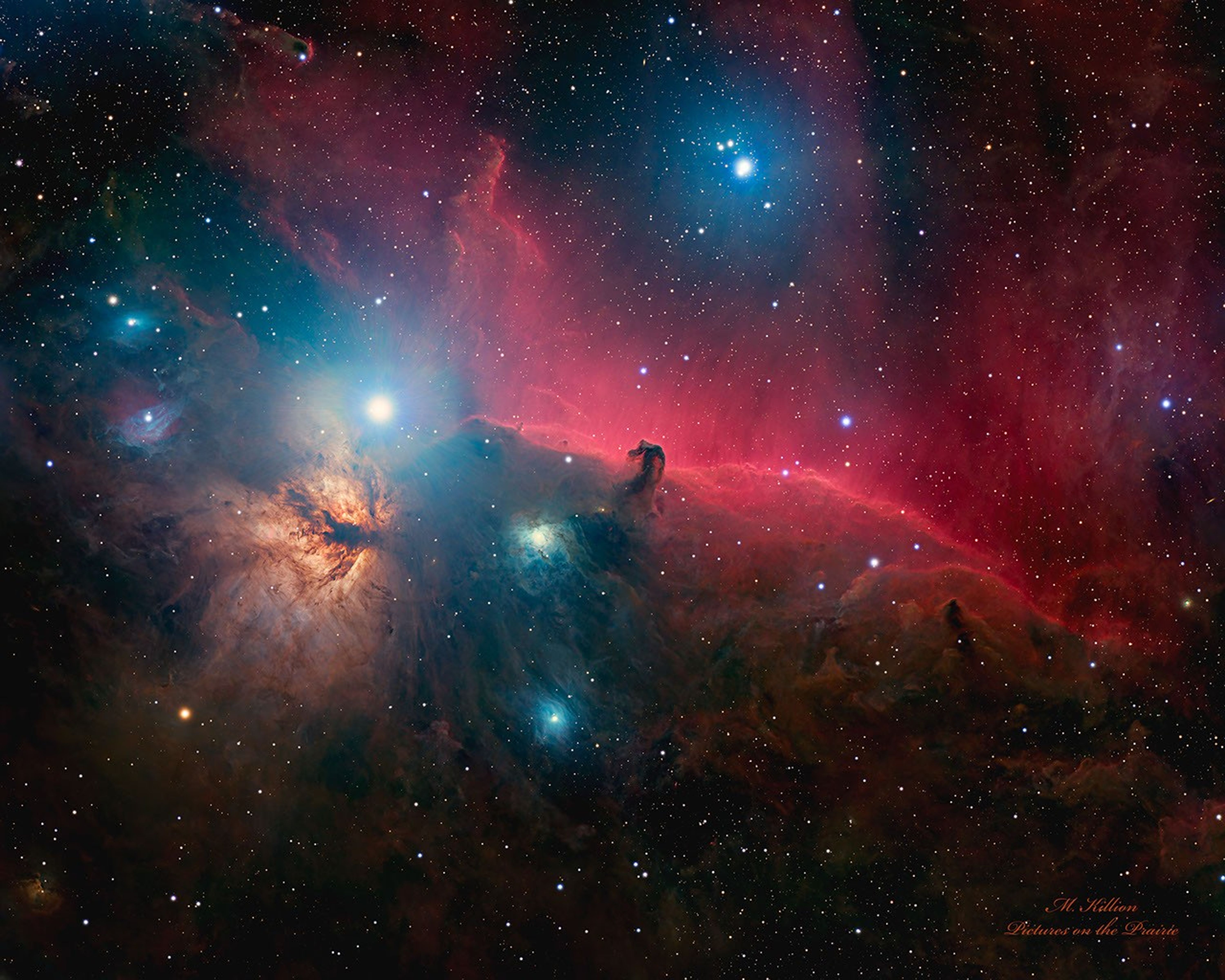
Explanation: Today's image could have been a painting. But what do these colors mean? The brightest star, left of the center, is blue Alnitak (the Girdle): a triple star system best known for being the easternmost star in Orion's Belt. The instantly recognizable shape of a dark horse's head at the center is the aptly named Horsehead Nebula. It is about five light-years tall and lies approximately 1,500 light-years away. It is made of dust and gas that obscure the red glow behind it, which is caused by hydrogen gas being ionized by the bright star Sigma Orionis at the top. The orange nebula with dark filaments on the left is the Flame Nebula. Closer to the Horsehead, the blue reflection nebula NGC 2023 is actively forming stars. The data for this "painting" were collected for almost six hours at the Utah Desert Remote Observatories, but the equipment was remotely controlled by the astrophotographer from his home, over 2,000 km away in Illinois. Tomorrow's picture: V-G-R
Image credit: Mark E. Killion. Copyright: Mark E. Killion. NASA source
Abstract We present the third and final data release of the Large Early Galaxy Astrophysics Census (LEGA-C), an ESO/Very Large Telescope public spectroscopic survey targeting 0.6 < z < 1.0, K s -selected galaxies. The data release contains 3528 spectra with measured stellar velocity dispersions and stellar population properties, a 25-fold increase in sample size compared to previous work. This K s
Galaxies: Formation, Evolution, Phenomena · Stellar, planetary, and galactic studies · Astrophysics and Star Formation StudiesView original sourceAbstract We present the second data release of the Large Early Galaxy Astrophysics Census (LEGA-C), an ESO 130−night public spectroscopic survey conducted with VIMOS on the Very Large Telescope. We release 1988 spectra with typical continuum S/N ≃ 20 Å−1 of galaxies at 0.6 ≲ z ≲ 1.0, each observed for ∼20 hr and fully reduced with a custom-built pipeline. We also release a catalog with spectroscop
Galaxies: Formation, Evolution, Phenomena · Stellar, planetary, and galactic studies · Astrophysics and Star Formation StudiesView original sourceAbstract We present a detailed study of the partial rest-optical (λ obs ≈ 3600–5600 Å) spectra of N = 767 star-forming galaxies at 0.6 < z < 1.0 from the Large Early Galaxy Astrophysics Census (LEGA-C). We compare this sample with low-redshift (z ∼ 0) galaxies from the Sloan Digital Sky Survey (SDSS), intermediate-redshift (z ∼ 1.6) galaxies from the Fiber Multi-Object Spectrograph (FMOS)-COSMOS S
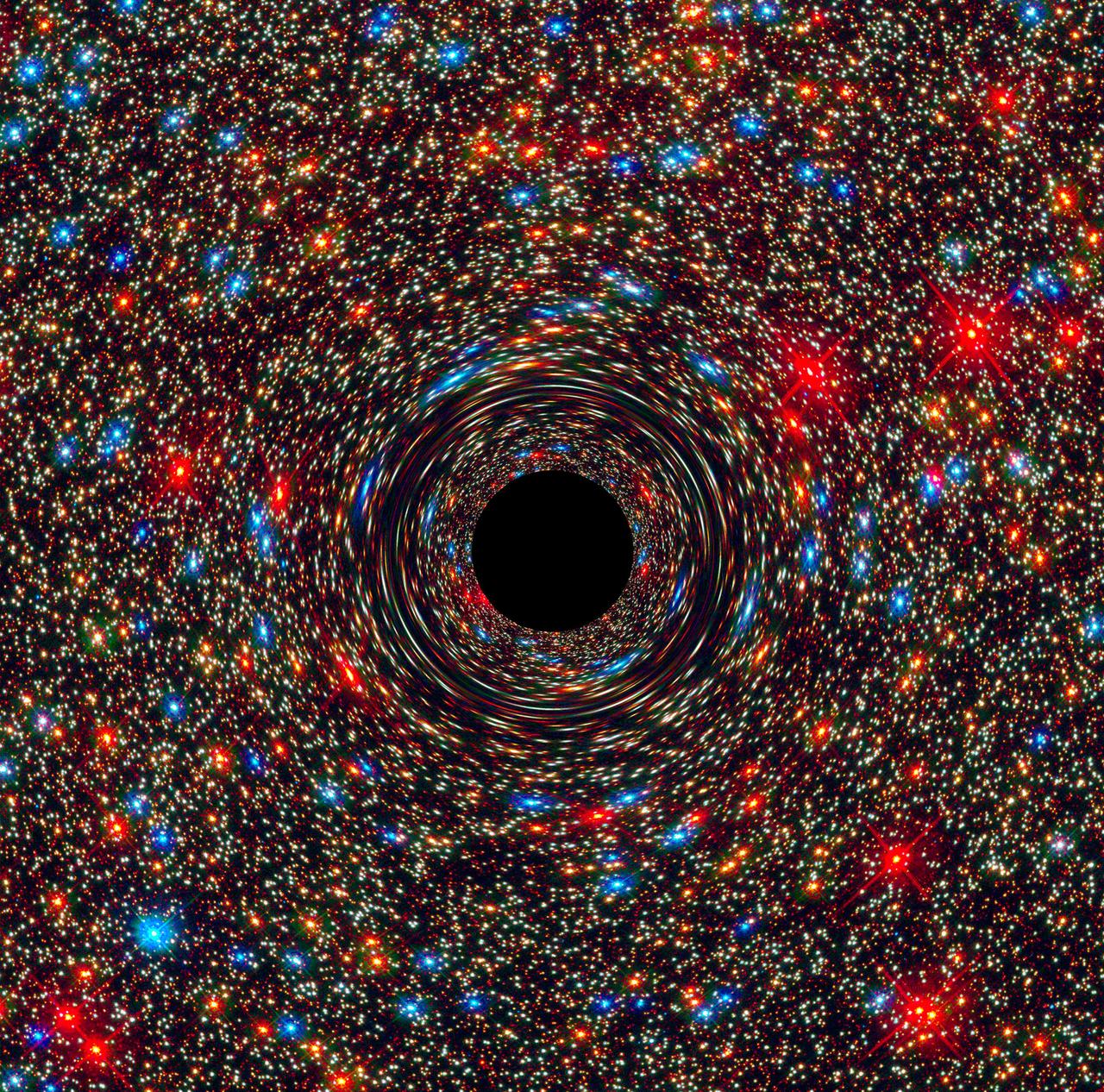
This computer-simulated image shows a supermassive black hole at the core of a galaxy. The black region in the center represents the black hole’s event horizon, where no light can escape the massive object’s gravitational grip. The black hole’s powerful gravity distorts space around it like a funhouse mirror. Light from background stars is stretched and smeared as the stars skim by the black hole. Credits: NASA, ESA, and D. Coe, J. Anderson, and R. van der Marel (STScI) More info: Astronomers have uncovered a near-record breaking supermassive black hole, weighing 17 billion suns, in an unlikely place: in the center of a galaxy in a sparsely populated area of the universe. The observations, made by NASA’s Hubble Space Telescope and the Gemini Telescope in Hawaii, may indicate that these monster objects may be more common than once thought. Until now, the biggest supermassive black holes – those roughly 10 billion times the mass of our sun – have been found at the cores of very large galaxies in regions of the universe packed with other large galaxies. In fact, the current record holder tips the scale at 21 billion suns and resides in the crowded Coma galaxy cluster that consists of over 1,000 galaxies.
View source item
The blue dots in this field of galaxies, known as the COSMOS field, show galaxies that contain supermassive black holes emitting high-energy X-rays. The black holes were detected by NASA's Nuclear Spectroscopic Array, or NuSTAR, which spotted 32 such black holes in this field and has observed hundreds across the whole sky so far. The other colored dots are galaxies that host black holes emitting lower-energy X-rays, and were spotted by NASA's Chandra X-ray Observatory. Chandra data show X-rays with energies between 0.5 to 7 kiloelectron volts, while NuSTAR data show X-rays between 8 to 24 kiloelectron volts. http://photojournal.jpl.nasa.gov/catalog/PIA20865
Credit: NASA/JPL-CaltechView source itemAstronomy is a natural science that studies celestial objects and the phenomena that occur in the cosmos. It uses mathematics, physics, and chemistry to explain their origin and their overall evolution. Objects of interest include planets, moons, stars, nebulae, galaxies, meteoroids, asteroids, and comets. Relevant phenomena include supernova explosions, gamma ray bursts, quasars, blazars, pulsars, and cosmic microwave background radiation. More generally, astronomy studies everything that originates beyond Earth's atmosphere. Cosmology is the branch of astronomy that studies the universe as a whole. Astronomy is one of the oldest natural sciences. The early civilizations in recorded history made methodical observations of the night sky. These include the Egyptians, Babylonians, Greeks, Indians, Chinese, Maya, and many ancient indigenous peoples of the Americas. In the past, astronomy included disciplines as diverse as astrometry, celestial navigation, observational astronomy, and the making of calendars. Astronomy is one of the few sciences in which amateurs play an active role. This is especially true for the discovery and observation of transient events. Amateur astronomers have helped with many important discoveries, such as finding new comets.
License: CC BY-SA 4.0View original sourceThe history of astronomy focuses on the efforts of civilizations to understand the universe beyond earth's atmosphere. Astronomy is one of the oldest natural sciences, achieving a high level of success in the second half of the first millennium. Astronomy has origins in the religious, mythological, cosmological, calendrical, and astrological beliefs and practices of prehistory. Early astronomical records date back to the Babylonians around 1000 BC. There is also astronomical evidence of interest from early Chinese, Central American and North European cultures. Astronomy was used by early cultures for timekeeping, navigation, spiritual and religious practices, and agricultural planning. Ancient astronomers observed and charted the skies in an effort to learn about the workings of the universe. During the Renaissance Period, revolutionary ideas emerged about astronomy. One such idea was contributed in 1543 by Polish astronomer Nicolaus Copernicus, who developed a heliocentric model that depicted the planets orbiting the Sun. This was the start of the Copernican Revolution, with the invention of the telescope in 1608 playing a key part. Later developments included the reflecting telescope, astronomical photography, astronomical spectroscopy, radio telescopes, cosmic ray astronomy, infrared telescopes, space telescopes, ultraviolet astronomy, X-ray astronomy, gamma-ray astronomy, space probes, neutrino astronomy, and gravitational-wave astronomy. The success of astronomy, compared to other sciences, was achieved for several reasons. Astronomy was the first science to have a mathematical foundation. Standardized measuring instruments such as armillary spheres and quadrants provided a solid base for collecting, verifying and communicating data. Throughout the years, astronomy has broadened into multiple subfields such as astrometry, planetary astronomy, astrophysics, astrochemistry, astrobiology, stellar astronomy, galactic astronomy, extragalactic astronomy, and physical cosmology
natural science studying celestial objects and phenomena in the cosmos
License: CC0View original sourcescientific journal covering theoretical, observational, and instrumental astronomy and astrophysics
License: CC0View original sourcevocal track by Conan Gray; 2021 studio recording
License: CC0View original source
